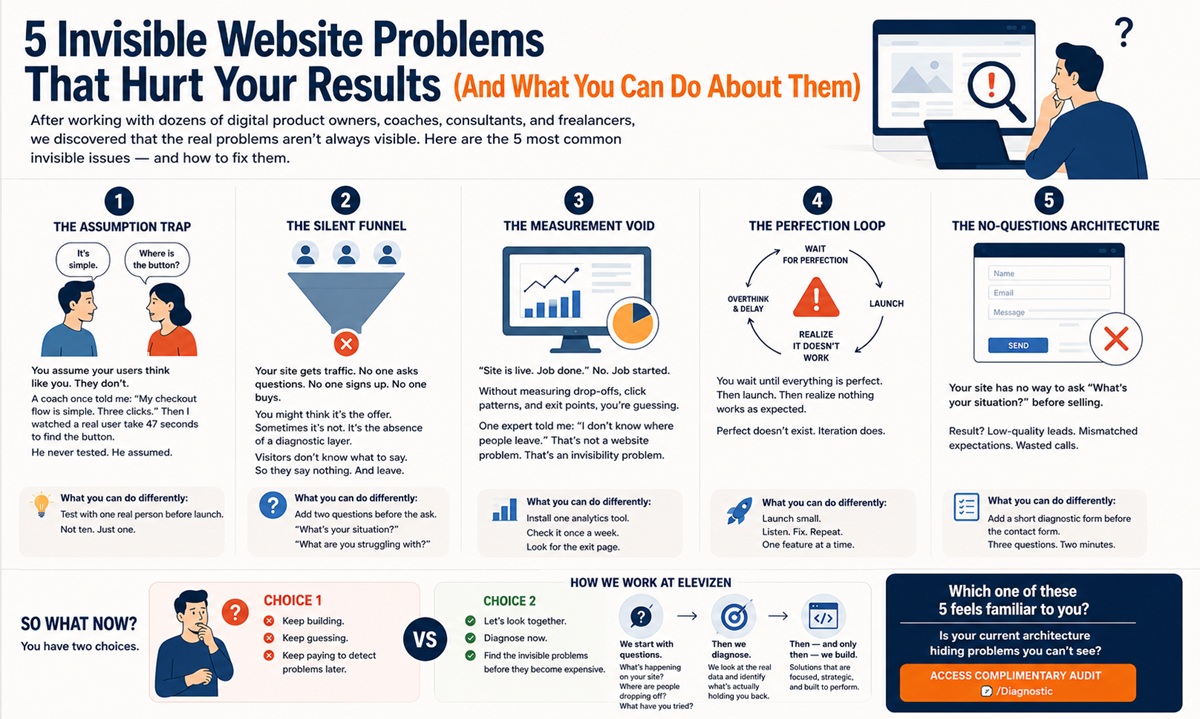
Introduction – The Scene
We received a message last month.
It sounded exactly like hundreds of others we’ve seen on Reddit, Quora, and LinkedIn groups:
> “I get 4,000 visitors a month. Maybe 3 sales. My current designer says the design is fine. I think everything is broken. Help.”
We’ve seen this movie before.
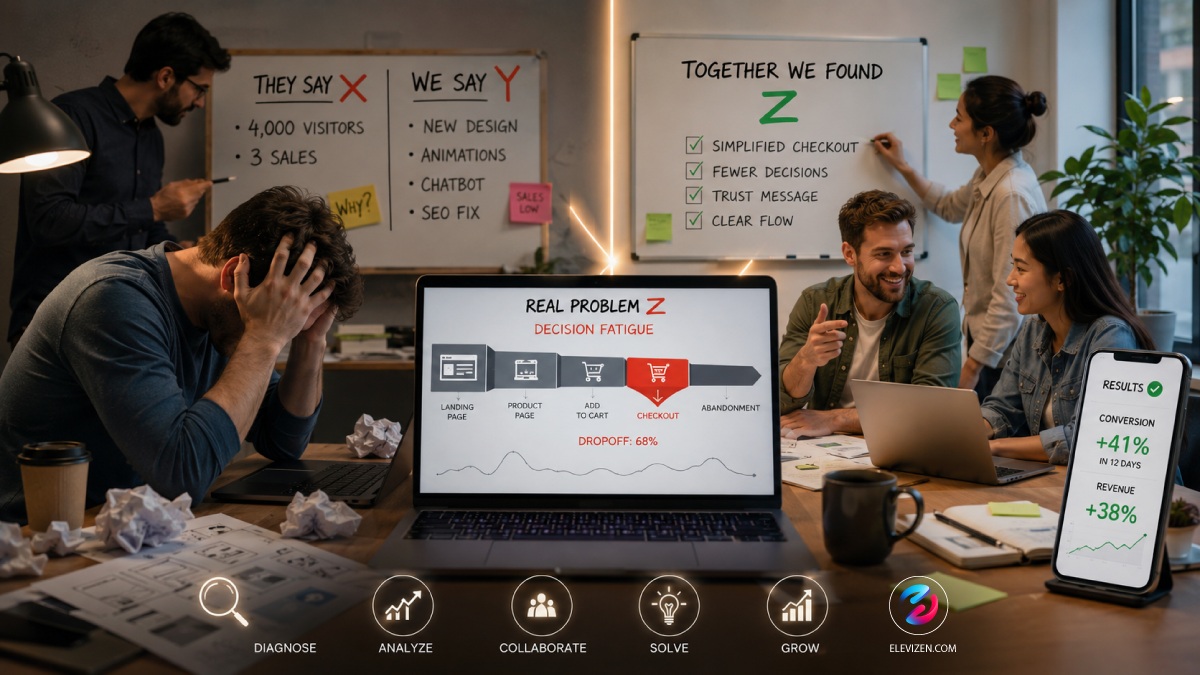
The client says X (traffic but no sales). The builder says Y (design is fine, maybe add a slider). Neither is saying Z.
Why?
Because touching Z means admitting no one has diagnosed correctly.
In 70% of cases we’ve examined, the builder already had a solution before hearing the problem.
That’s not a solution. That’s a product.
---
Chapter 1 – What the Client Actually Says (X)
We collected real data from:
- Reddit (r/ecommerce, r/shopify, r/smallbusiness) - Quora (“why my website fails”) - LinkedIn comments under CRO posts - Gumroad creator complaints - Facebook groups for digital sellers
The pattern is painfully consistent:
- “I redesigned everything. Nothing changed.” - “My developer says the site is fast and beautiful. But no one buys.” - “I tried adding trust badges, reviews, even discounts. Still nothing.”
Clients are not stupid. They know something is wrong. They just don’t know what.
And that’s not their job. That’s ours.
---
Chapter 2 – What the Builder Says (Y)
We also analyzed replies.
Agencies, freelancers, and AI-platform operators almost always say the same thing:
- “Your design is outdated.” - “Let’s add more animations.” - “We need a new homepage layout.” - “Your SEO meta tags are weak.” - “You should add a chatbot.”
Notice something?
None of these start with a question. They start with a product.
Why?
Because most builders are afraid to say: “I don’t know yet. Let me diagnose first.”
They fear losing the client. They fear admitting uncertainty. So they sell what they already know how to build.
Not what the client actually needs.
---
Chapter 3 – The Hidden Wound (Z)
Here’s what we found after spending 3 days on this specific case.
The client said: “4,000 visitors, 3 sales.”
The previous builder said: “Design is fine.”
We didn’t believe either. We pulled the data ourselves.
- Google Analytics 4 (actual user flow) - Microsoft Clarity (session recordings) - Hotjar heatmaps (where people clicked) - Checkout funnel (where they dropped)
Teşhis (Diagnosis):
The design was actually fine. The speed was acceptable. The product images were good.
The problem was decision architecture.
Visitors landed, browsed, added to cart… then left at the shipping step.
Not because shipping was expensive. Because the site asked for too many decisions at once.
Country → city → postal code → shipping method → payment → confirmation email → newsletter opt-in → account creation.
Seven decisions. On one page.
That’s not a checkout. That’s an exam.
---
Chapter 4 – Why No One Touched Z Before
The client didn’t know “decision fatigue” existed. (Why would they? They sell products, not psychology.)
The builder didn’t want to say: “Your checkout might be broken.” Because that sounds like criticism. And criticism risks the deal.
So everyone stayed safe.
The client blamed themselves. The builder blamed the design.
And Z stayed untouched.
This is the silent epidemic of the web industry. Not bad code. Not ugly design. Fear of the real diagnosis.
Most websites don’t need a redesign.
They need a re-diagnosis.
---
Chapter 5 – How We Fixed It (Together)
We didn’t start with “let me rebuild your site.”
We started with:
> “Let’s look at your real data together. No assumptions. No templates. Just what happened.”
We shared our screen. We watched session recordings together. We asked: “What do you see here?”
And the client said: “Oh my god. They’re leaving because I’m asking too much.”
That moment — that moment — is the entire point of Elevizen.
Not selling a fix. Discovering it together.
The fix itself was simple:
- Removed 4 form fields - Moved account creation to after purchase - Added a one-line trust message
Result: Conversion increased by 41% in 12 days. Same traffic. Same design. Same product.
Only the decisions changed.
---
Chapter 6 – The Bigger Pattern (For You, Reading This)
If you’ve read this far, you’ve probably felt something familiar.
Maybe your website has traffic but not sales. Maybe you paid for a redesign that changed nothing. Maybe your builder said “everything is fine” but you know it’s not.
You are not wrong. And you are not alone.
The problem is almost never: “We need a better slider.”
The problem is almost always: “No one stopped to diagnose.”
---
Conclusion – Either We Find a Way, or We Create a New One
This is why Elevizen exists.
Because the industry is full of people selling solutions before hearing the problem. Full of fear-based decisions. Full of “let’s add one more thing” instead of “let’s remove what’s broken.”
We don’t start with solutions. We start with diagnosis.
Data. Observation. Collaboration. Then — and only then — action.
Either we find a way, or we create a new one.
If this story sounds like yours, you already know what to do next.
Join Leading Growth Strategists
The same conversion tactics we use for our premium clients, delivered to your inbox every Friday. Zero noise. All data.
Is your current architecture costing you conversions?
Is your current architecture costing you conversions?
Expand Your Authority
One ecosystem, infinite growth. Bridge your expertise into our specialized platforms designed to scale every facet of your digital empire.
CREAIZEN
Bespoke digital architecture for high-ticket service providers.
ORIGINIZEN
Deep-authority training and frameworks for the 1% of creators.
USEFULIO
The curated tech stack and partnership engine for scale.
VIRALICH
Flash-point launches and viral content training for maximum reach.
Community Discussion
0 Registered Opinions
What niche problem can we solve next?
We don't just write articles; we build protocols for elite operators. Tell us exactly where your scaling is stalling, and we'll engineer the next release around it.